The sustainable notebooks project was a personally instigate brief with the specific aim of allowing me to practice my craft based bookbinding skills which I had not had the chance to explore since starting university in September.
As a designer, a large aspect of my practice is based around craft, hands on production and sustainability, aspects which are derived from my personal interests and ethical beliefs. The notebook project allowed me to engaged all three of these aspects, pushing my knowledge of craft and challenging my understanding of sustainable production through the attainment of appropriate materials for the notebooks. The outcome was a series of notebooks that not only showcase my ability as a craftsman, but also acknowledge my ethical believes while simultaneously creating a unique promotional piece that represents all of the above.
One of the main aims of the project was to create an artist sketchbook that was made completely from reclaimed or reused materials, completely removing the need to purchase new materials for the project, a decision that was made for environmental reasons and not monetary. To successfully achieve this I reclaimed all of the stock that is used to form the pages of the notebooks from bins and table tops located around university, a process that in total took way over a month. Continuing with the reclaimed material ethos, the grey board covers were created from a surplus of waste stock I saved from a series of misprinted business cards created earlier in the year. The string used to bind the books was the only element of the sketchbooks that was purchased, a decision that was made after a consistent source for string could not be found. To ensure the only purchased item was as environmentally friendly as possible, hemp string was purchased from a UK supplier, reduing the amount of miles the product had to travel before reaching me. Overall, because of the methods used to collect materials each individual notebook has a minimal carbon footprint and in fact helps to save energy through the reduction of materials transported and subsequently recycled.
The project was undertaken at a busy time of year, as a number of larger projects had just been started. The Coptic binding method outlined on the initial brief is time consuming and tedious, requiring a large amount of time for the production of each individual notebook. Therefore, my time management and organisational skills were put to the test, as the production of each individual notebook had to be balanced along side the other ongoing briefs. Despite the challenge, I managed to keep on top of the workload by devoting an hour and a half a night to the production of the notebooks.
As well as forming relevant promotional pieces I can give away and sell I also decided to use one of the notebooks as the sketchbook for my design publication, the concept for which is heavily based around the hand rendered exploration of collected research.
Overall, I found the project thoroughly enjoyable as for the first time in months I was able to practice my craft skills and produce a set of products that not only have relevance to my practice, but form promotional pieces I can distribute to fellow students and professionals.

Showing posts with label NOTEBOOKS. Show all posts
Showing posts with label NOTEBOOKS. Show all posts
Saturday, 14 February 2015

Thursday, 12 February 2015
PPP3 - NOTEBOOK - FINAL IMAGES
Following the initial shoot which produced a body of images showcasing the various characteristics of the reclaimed paper notebooks, I began a process of refinement to help define a final selection of images.
The selection of images below document the refined selection of edited photographs.


PPP3 - NOTEBOOK PHOTOGRAPHY
After I had completed the long process of physically producing the individual notebooks I progressed with the project by organising a promotional photo shoot with a photography
student.
Currently, I am very busy with other ongoing projects for the Extended Practice and PPP modules. Therefore, organising the shoot with a student from third year photography allowed me to personally save time and resulted in a set of professional promotional images for the series of sustainable notebooks.
I have listed some of the benefits of taking promotional images below;
- Used to raise awareness of booklets which consequently helps with their sale.
- Allows me to use the project as an original portfolio piece.


Friday, 30 January 2015
PPP3 - NOTEBOOK PRODUCTION
Images below document the step by step process of creating the sustainable notebooks, from trimming the collected paper to binding the individual booklets.
COLLECTED PAPER
The image below displays the range of waste paper stocks that were collected throughout the first five months on the course.
The stock, which will form the covers and interior pages of the notebooks, was collected from bins and tables from around the university, and so would have otherwise been sent to be recycled. By collecting and using waste paper stock instead of buying some recycled stock from the internet I am able to vastly reduce the carbon footprint associated with the notebooks.
CARBON REDUCTION -
- Saves the energy associated with sorting, transporting and recycling the waste paper.
- Saves having to buy new recycled stock for the notebooks helping to avoid the energy use associated with making and transporting the recycled paper.
 |
| Stock collected over a four month period. |

 |
| I also collected some recycled grey board for the notebook covers that had previously been used to print business cards. Luckily for me, the board was unused due to a misprint. |
TRIMMING
The stock that was collected came from a range of sources and undoubtedly had been used for a range of purposes. A consequence of using waste paper was the varying sizes of the individual sheets. One of the first major tasks that needed completing as part of the project was the process of trimming all the sheets down to the same size.
 |
| Paper was trimmed using the guillotine. |
 |

 |
| Paper was trimmed to an A4 size so that when folded it met the outlined individual page size of A5. |
NOTEBOOK PRODUCTION
The sheets of trimmed paper were taken back to my house where I completed the various stages of the binding process.
 |
| Tools used during the binding process. |

 |
| Folding the paper was very tedious and took over three hours. |
 |
| Paper was arranged into piles of stock type, this helped when creating the individual signatures. |
 |
| The signatures consisted of six folded pages and varied in stock type giving the books a lot of character. |
 |
| An etching needle and custom template were used to pierce holes through each signature. |
 |
| Each booklet will feature five signatures giving a total of 120 individual pages. |
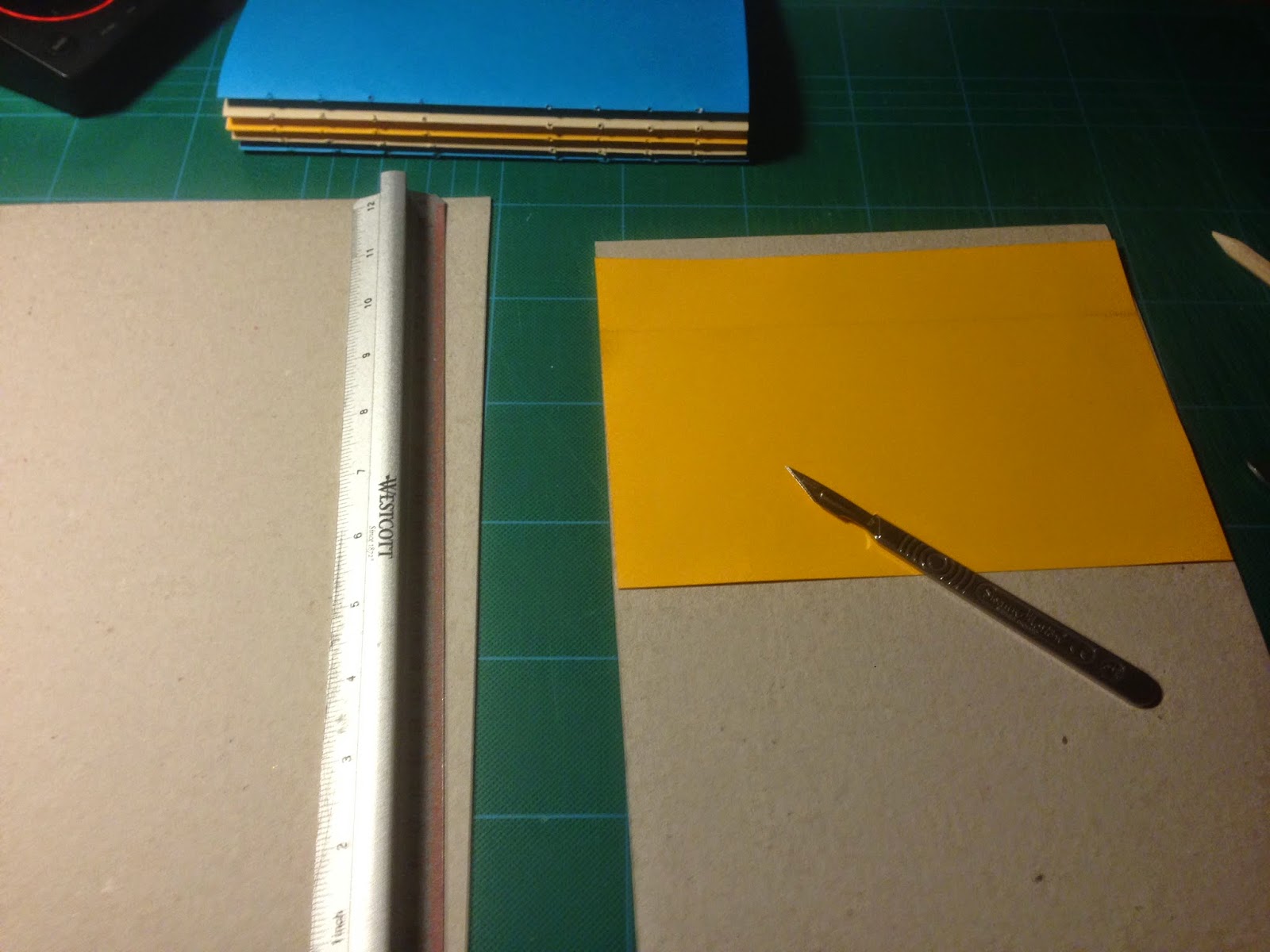 | ||||
A singular signature was used to measure the size of the grey board cover.
|


 |
| The coptic stitch was completed using hemp string, a stronger and more sustainable alternative to most conventional twines. |
FINISHED NOTEBOOKS
After the stitching process was completed the notebooks had any excess trimmed from the pages and covers to ensure that they are neat and finished to a professional standard.
Once the process of trimming was complete the sustainable notebooks were ready for photographing and sale.

Monday, 26 January 2015


Subscribe to:
Posts (Atom)