Showing posts with label SUW. Show all posts

Wednesday, 13 May 2015

PPP3 - START UP WEDNESDAYS - NEXT STEPS WITH YOUR BUSINESS

Today, I attended the final 'Start up Wednesdays' session of the academic year.Once again Keith Evans took the session, however this time he discussed the steps we now need to undertake to get ours businesses started.

Due to the busy time of year, only me and another student turned up to the session which meant that we got a personal, one on one session with Keith. 

Initially, to give him an understanding of where we are currently at with our ideas, we talked through the journey so far, covering what first inspired the idea and any current progress we have made.

Notes taken during the session can be seen below;

IMPORTANT POINTS;
  • Matt Smith - Works at the Key Fund. 
  • Costing needs to be spot on from the start.
  • Always maximise on trade-offs.
  • Become obsessive about your customers, get to know them!
  • Identify the key players that will help your business excel.
    • Individuals in locations.
    • Groups.
    • Organisations.
    • Other businesses. 
  • Networking is key.
  • The back story is hugely important to customers.
    • People want to know about how you started, beliefs etc.
    • Show process of making product.
    • What makes the product individual?
    • Highlight values.
  • Structure your marketing - who has the most relevance to the business?
  • Set goals.
  • Create a growth plan.
  • Create a pitch about your business and product.
  • Marketing should start with why you started the company, not with the product.
  • Research, research, research.
  • Break down large tasks as it makes them easier to manage. 
  • Express what you do without overselling.
    • How the product is made.
    • How transported.
    • Why it is better than the competition.


Wednesday, 29 April 2015

PPP3 - START UP WEDNESDAYS - EVERYTHING LEGAL

Today I attended another one of the 'Start Up Wednesdays' sessions which, this week, was headed by an enthusiastic and engaging solicitor called Keith Arrowhead. 

The session was very useful and thoroughly enjoyable as Keith presented us with a range of relevant legal advice and information on how to choose the correct legal structure for a business while simultaneously telling fascinating stories with relevance to the topic in hand. 

As a student considering starting my own venture, the information Keith gave us was invaluable, enlightening and essential knowledge for anyone thinking of becoming self employed. 

Unfortunately, only a select number of students turned up for the session, however, this subsequently meant that Keith could learn about our  business ideas and give us legal advice specifically suited to our own individual ventures. 


Notes taken during the session are listed below;


IMPORTANT POINTS;
  • Creative cultural skills - Intern funding - VERY USEFUL! 
  • A good lawyer brings clarity to a situation. 
    • Knows about a business and its aims.
    • Helps to achieve.
  • There is no protection for a business idea - people could easily steal.
    • Choose the time to reveal your idea carefully.
  • Businesses need structure.
    • What type of business do I want?
    • Joint ventures and collaborations are the same things with different names.
    • In co-operatives, each member has a vote.
    • A sole-trader is a one person business - personal assets liable for seizure if bankrupt.
    • Incorporate to avoid personal liability.
  • Companies house - Website for checking business name availability - VERY USEFUL! 
  • Knowem.com - website for checking social media name availability - VERY USEFUL!
  • Businesses can be protected by a trademark - This is free.
  • However a registered trademark is not free - registration costs £170 and lasts 10 years.
  • Design rights protect how a design looks.
    • £60-70 for 10 years protection.
    • 1 year to decide whether to protect.
  • All design work is protected by copyright - you do not have to register anything.
  • Acknowledging your copyright shows value of work.
  • Copyright is always retained by the creator unless they are working for a company or a deal is made.
  • Copyright lasts for 70 years. 


Wednesday, 11 March 2015

PPP3 - START UP WEDNESDAYS - NICK SCOTT 1-2-1 SESSION

Today I attended a 1-2-1 session with Nick Scott, an individual who has a wealth of knowledge and experience with the various aspects of setting up businesses within the UK. 


BUSINESS PLAN 

In preparation for the session I printed off the current version of my business plan so that I could talk through it with Nick to help her get an understanding of my idea and the extent of my current research and development.

The business plan that was taken to the session can be seen in the images below;


Additional to the business plan I also took some supplementary documents to help communicate my idea in an accurate way. As Nick was uninformed of the variations in size and width between a cruiser skateboard and normal skateboard it was hard to visualise what I was describing without the support of a visual example. Therefore, one of the print offs I took to the session which really came in useful when explaining the specifics of my idea was the image of a cruiser deck cut out of the larger skateboard deck. 


SESSION NOTES 

Overall, the session was very informative and presented me with aspects of starting up a business I had not considered up until this point.

Notes taken during the session with Nick are displayed below; 


IMPORTANT POINTS; 
  • Nick had three immediate questions after hearing my business plan;
    • What is the current size of the skateboard market? (UK)
    • What is the current size of the skateboard market? (GLOBAL)
    • Access to old skateboards - how will this be achieved? 
  • Who is the business plan for?
    • Segmenting a business plan for its target audience is very important, a BP for a bank would include in-depth analysis of costing and profit. 
  • Enterprise Nation - Website offering support for small businesses.
  • Social enterprise - type of ethical business that donates percentage of profit to charitable or social cause.
    • Special start up grants & loans available to social enterprise businesses.
    • UnLtd - Site offering help to social enterprise businesses.
    • Key fund (Yorkshire) - Funding & loans for social enterprise businesses.
    • Social Investment Business - Support for social enterprises.   
  • Marketing should target different segments of the audience. 
  • Networking is important - consider product conventions and press releases.
  • Set income targets.
  • PESTE analysis - helps with strategic planning. 


Wednesday, 4 March 2015

PPP3 - START UP WEDNESDAYS - MANAGING YOUR MONEY

Today I attended the next 'Start Up Wednesdays' session which was headed by an inspiring individual called Keith Evans, who is the Managing Director of a Leeds based company called 'Cida Co'. 


Cida Co are a training and consultancy company who help creatives put their entrepreneurial dreams into action by providing them with the right information and support to do so. Despite their broad range of focuses todays session was specifically focused on how to manage money - a subject I still have a lot to learn about!


SESSION NOTES; 

The session provided us with a mountain of relevant information and advice from how to budget to how to charge clients correctly. However, undoubtedly the most beneficial aspect of the session was the Microsoft Excel documents that were made available to us. The first document allows us to work out how to charge clients properly and the second allows us to identify the cash flow through our hypothetical business.

Notes taken in the session are listed below; 


IMPORTANT POINTS;
  • You have to be confident when discussing pricing or people will try to exploit you.
  • Topics covered;
    • Budgeting.
    • Costing & Pricing.
    • Cashflow.
  • Costing and pricing are not the same thing;
    • Costing is how much it costs us to do a job or make a product.
    • Pricing is how much we charge for that job or product.
  • Overheads are financial outgoings that we have to pay to survive and can be fixed or variable.
    • A fixed overhead would be outgoings such as rent & utilities.
    • A variable overhead would be outgoings such as internet & travel.
  • Pricing can be affected by tangible factors;
    • Geometry - work is cheaper in China.
    • Reputation.
    • Competition - will someone do it cheaper.
  • Pricing will cover both wholesale and retail.
  • When pricing/charging clients it is important to be able to articulate what they are paying for - why are we so good?
  • Pricing can be split into two sub-sections;
    • Money needed to survive.
    • Desired amount of money.
  • The amount of money needed to survive is divided by the amount of hours you work in a year to define a rough hourly based rate.
  • 'Cash flow' is the flow of money through a business. 
  • Regularly reviewing the cash flow can help to detect future problems.
  • Calculated risks are much better than blatant risks.  
  • Analysing your cash flow can help you evaluate risks.
  • Documenting your cash flow can help you to identify peaks and dips in profit throughout the year.
    • Allows you to identify downtime.
  • Keeping detailed records such as cash flow can help you to attain loans from the bank.
    • Repayment can be factored into cash flow.
  • Columns of the Cash Flow document can be updated with real figures as the year progresses for a more accurate understanding of the businesses finances. 


PRINTED MEDIA 

As part of the session we completed various small tasks which had relevance to the information discussed allowing us to put the theory into practice.

The images below display some of the forms received as part of the session; 

Sheet allowed us to assess our profit and loss.  
The above sheet was a printed version of the costing & pricing excel document Keith talked through.   


Wednesday, 18 February 2015

PPP3 - START UP WEDNESDAYS - HOW TO BECOME SELF EMPLOYED

Today, I attended the first 'Start up Wednesdays' session since the two I missed over the COP3 submission period. Due to the combination of a heavy workload and an impending deadline created by preparing for the deadline I had to miss one of the 'SUW' sessions, a choice which unfortunately meant that I couldn't attend the following session that continued on from the points covered in the session I missed. 

The session that I attended today was called 'How to Become Self Employed' and featured a guest speaker called Russell Smith, a self employed accountant from Leeds who specifically works with creative industry professionals. Due to his experience, Russell had valuable insights to offer us on both how to become self employed and how to manage your accounts when you do. 

Some of the main topics that covered in the session are listed below;

SUBJECTS COVERED -

  • Becoming self employed.
  • Registering as a company.
  • Calculating profit.
  • Income & expenses.
  • Records - What needs keeping.
  • Paying Tax.


SESSION NOTES 

The session presented me with so much relevant information and simultaneously inspired me on many levels. Throughout the talk I recorded any important information I thought could be of use or have relevance to my future career decisions.

Notes taken during the session are displayed below;


IMPORTNAT POINTS -
  • Becoming self employed is easy - help is available for the newly self employed by calling 0845 915 4515.
  • Newly self employed people get a National Insurance Class 2 tax code.
  • You can be self employed and employed by another employer at the same time.
  • Becoming self employed is easy but leaves you susceptible to personal bankruptcy - becoming a limited company is much more complicated and expensive but protects you from becoming personally bankrupted. 
  • One route is to initially be self employed then list yourself as a limited company as you grow. 
  • Limited companies need accountants - Yearly fees are around £3-500.
  • When becoming self employed split your money into accounts - Personal and Business.
  • Business expenses cannot be claimed on taking clients out for meals.
  • Fill in the note sections on tax returns, it looks like you are trying to disclose more and helps to avoid becoming investigated by HM Revenue & Customs.
  • Profit = Income - Expenses.
  • Businesses are taxed on profit not income when you are self employed so claim as much as you can on your expenses!
  • Grant based income is not usually taxed.
  • Changingcourse.com - useful information on becoming self employed. 
  • Record everything, Keep everything for tax returns.
  • If you have expenses before starting the business that are then brought into the business you can claim on it under expenses.
  • When you care self employed you must remember to keep enough money to pay the tax man - By keeping 18% of the income all tax should be covered + give you a little bonus.
  • Some business owners use three bank accounts - Personal, Business and Tax.
  • Vat is only relevant after £81000.
  • Making your payment terms clear and ensuring they are understood by the client makes collecting payment much easier.
  • Profit does not always mean cash if you are not collecting it from your clients. You could earn £20000 but it may not be in your account until the clients pay - Problems such as this can lead to bankruptcy. 
  • Manage finances on the worst case scenario.
  • A fine can be given if you start a business and don't register it within the first three months of operating. 
  • Tax year starts on the 5th of April - Tax paid on the 31st of Jan of the following year.
  • If you earn over £13000 in your first year you will be taxed a year and a halves worth of tax.
  • Pensions - we all get a state one, but this is hardly enough to survive - As soon as you can start paying into your pension do it as there are many benefits later down the line.
  • Grants and funding can be gained from wealthy people with cash to spare.
  • Common problems with becoming self employed - Cash Management - Caught out by tax - Unable to make enough money.

Russell finished the session by enlightening us with his 10 business tips, all of which are listed below -

10 BUSINESS TIPS - 
  • Don't read the papers and watch the news everyday - they are depressing and you need to be very positive. 
  • Surround yourself with positivity and experienced people.
  • Who customers buy from is more important than what they buy - Sell yourself, sell your company.
  • Get good at sales and marketing as quick as you can.
  • Don't undervalue yourself, don't try to be the cheapest, get your prices right.
  • Pay attention to your attitudes towards money.
  • Keep on top of your costs - always consider how you can make more money.
  • Read, listen and learn as  much about business as you can.
  • Network everywhere you go.
  • Get a great accountant who understands the creative sector.


CONCLUSION 

Overall, I found the session invaluable, it presented me with a huge body of relevant information all of which had direct relevance to both starting a business and progressing into the creative industry. The session was engaging, inspirational and is something I would recommend to anyone thinking of becoming self employed. 


Wednesday, 19 November 2014

PPP3 - START UP WEDNESDAYS - BUSINESS IDEA

At the end of the 'Start Up Wednesdays' session I was approached by Tom Hammond who sat in during the session and watched our business proposals, he briefly mentioned that he thought my proposed idea had scope for development and could be established as a functioning business. To help me progress from the inital point of just having an idea Tom requested that I type up my idea and send it to him so that he can review it in more detail. 


Using the COSTAR method covered during the session I quickly summarised my idea and forwarded the information to Tom;


Jordan Harrison Reader – Business Idea

Customer profile –
The primary target audience will consist of skaters and long boarders situated within affluent westernised countries such as the United Kingdom, America and Australia.
Members of the primary market are lifestyle conscious, predominantly male and aged between 14 and 30. Additionally, the audience will have moderate incomes and have access to expendable income. Moreover, members of the primary audience have an interest in sustainability and environmentally friendly products.
Additionally, a secondary target audience will consist of people aged between 14 and 25 that don’t necessarily skateboard but are interested in skateboard cruisers as a means of transport and because of their current popularity.

Opportunity –
Within the past few years there has been an eruption of interest in skateboard cruisers such as the ones sold by the Australian based company ‘Penny’. Due to their attributes such as their light weight, small portable size and soft wheels the cruisers are predominantly used by customers as a means of transport for short distances.
Most of the companies currently producing skateboard cruisers are doing so on a mass scale using materials that are unsustainable and damaging to the environment. There are existing companies producing cruisers that have a wooden deck however, this often entails the felling of trees to get the material. From the current market research collected as part of the business idea only one other company has been identified that creates cruisers using reused materials (Satta skates use wood reclaimed from timber yards.

Solution –
The product will take advantage of the current gap in the market left by companies selling mass produced cruisers that use unsustainable materials in various parts of the production process. Companies such as Penny (who are currently dominating the market) utilise a polypropylene plastic to create the deck and polyurethane to create the soft cruiser wheels, although robust these materials are both unsustainable and harmful to the environment.  
To exploit the gap in the market the product will be created using strictly environmentally friendly resources, for example the cruiser deck will be created from old skateboards that will be cut down to the desired size and shape meaning that the materials are reused and don’t require any consumption. Moreover, the wheels will be purchased from a company called Satori who have pioneered a technology that creates cruiser wheels using the recycled cores from old skateboard wheels and a corn starch mixture to form a soft, urethane like wheel. The process allows Satori to create wheels that aren’t harmful to the environment and are (from my market research) the only company in the world to currently do so.
With regards to aesthetics, each board will have a hand painted or printed illustration on the bottom that will reflect the company identity and ethos. Only small runs of each graphic will be created meaning that each graphic will be limited, this in turn should in turn create a consumer demand for the product.    

Team –
As the production process for the product is very simple and requires little physical input other than the cutting down of the deck and the creation of graphics I believe that I am completely capable of running the company on my own. Moreover, an additional benefit is that my course (Graphic Design) has prepared me for the creation of the company brand identity, development of any additional print collateral and the marketing schemes used to promote the company.
Although I will be solely responsible for running the company I plan to utilise the services of an accountant to keep on top of the accounts and taxes.

Advantage –
The product has an advantage over other products as it reuses old skateboards and other sustainable materials in its production. No other products that are currently available on the market utilise reused skateboards for the deck meaning that the idea is original and stands out from the crowd. Additionally, the fact that the product is created using sustainable processes means that it is an appealing purchase for consumers who are mindful of the ethics of companies they buy from.

Result –
The result of all of the above is a small company that produces and distributes a sustainable skateboard cruiser that takes advantage of a small gap in a lucrative market. The attributes that make the product individual are also the ones that will appeal to customers, such as the its eco-friendly qualities and original aesthetics.

Problems –
The only problem I have currently been able to identify relies with the supply of old skateboards which would need to be donated by skateboarders within the UK. To solve this problem I thought of two possible solutions. One, offer skateboarders an reason to donate the deck, this could be a small amount of money or a percentage off the cost of a crusier, and two, establish relationships with skate shops around the UK and create a marketing campaign that directs customers to take their old skateboard at the specified location. 

PPP3 - START UP WEDNESDAYS 2

Today I attended the second, extra curricular 'Start Up Wednesdays' session hosted for students that want to set up their own business or enterprise. 

In the session we had a guest speaker named Steve Manthorpe, a practicing artist who is also involved with various other enterprises such as Light Night in Leeds.

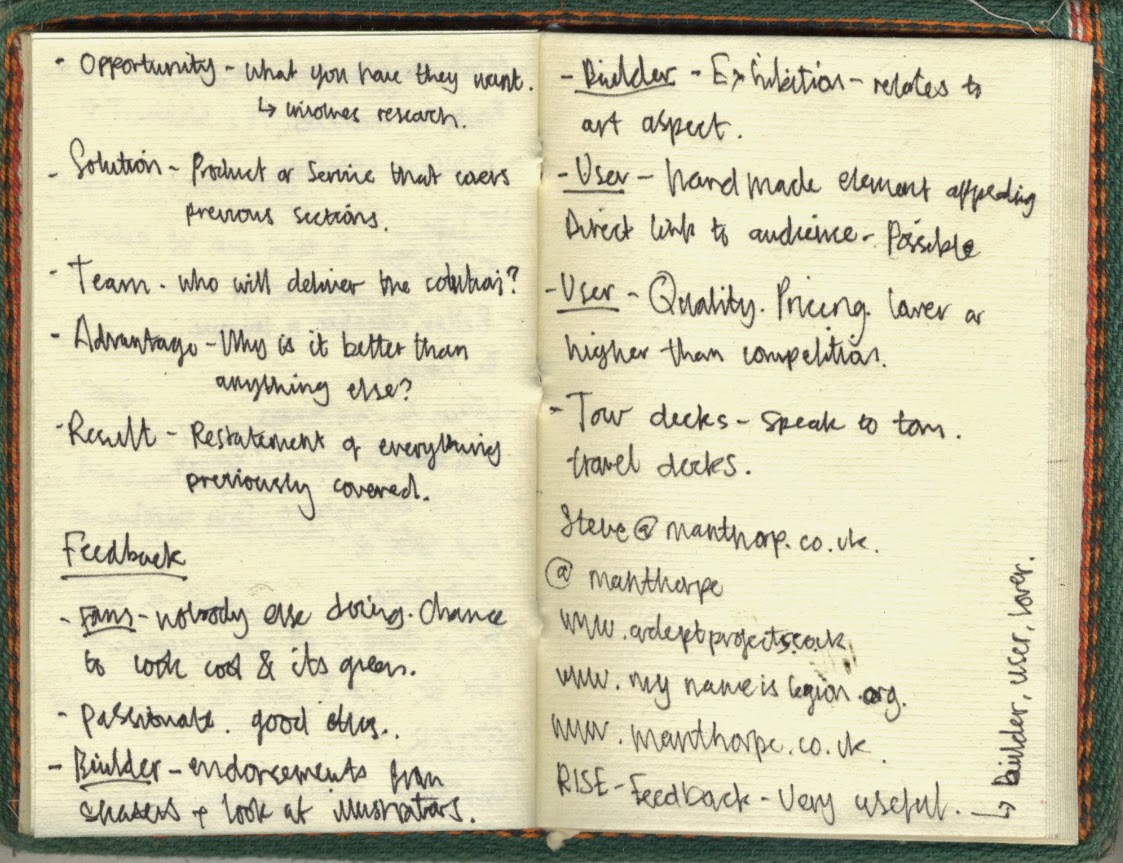
The session was started by going through the basics of what makes a business, notes that were taken during this part of the session are listed below; 


Additionally, at the end of the session we were given a print out that featured the slides Steve talked through during the session, this is useful as it features information that I missed.


After Steve talked though the specifics of what makes a business we were divided into small groups to complete a task. Using the 'COSTAR' method of assessment we were asked to talk though a business idea using each of the sections listed below;
  • Customer - Identify, characterise, role-play.
  • Opportunity - What you have they want.
  • Solution - Product or service you will offer - covers previous sections.
  • Team - Who will deliver the solution?
  • Advantage - Why is it better than anything else?
  • Result - Summary of most important points discussed.

As I had the most developed idea of my group we decided to use the 'COSTAR' assessment method to evaluate my business concept. Notes were listed on large sheets which I stupidly forgot to take pictures of.

After creating points for each section of the assessment method on large pieces of paper we had to present the idea to the rest of the group, who then in-turn gave feedback on the idea. 

Something that really grabbed my attention, other than the feedback given on my idea, was the method used to organise and create the feedback. Steve used a method called 'RISE' which divided the group giving the feedback into three sections; Fans, Builders & Users. It was the job of the fan to list all the positives they perceived from the idea setting a positive tone immediately. Next, it was the job of the builders to offer feedback that built upon the idea, giving information on what could be done to possibly improve it. Finally, it was the job of the user, who had to imagine they were a part of the target audience to say if the idea appeal to them and why. The feedback method worked really effectively, allowed students to discuss ideas and generated lots of informed useable information. In fact, I found the method so efficient that I plan to propose using it in future criticisms.    

Overall, I thought the session was really useful, gave me plenty of relevant information and filled me with confidence about my idea. 


Thursday, 23 October 2014

PPP3 - START UP WEDNESDAYS - INITIAL SESSION

Today I attended an extra curricular session called 'Start Up Wednesdays' which is a programme that is designed for students who want to work for themselves or have an idea or a business they want to develop as an enterprise. 

As I am currently unsure what career direction I want to take after after university I decided to attend the sessions to help me get a better idea of what I want to do and how to achieve it. Another reason I decided to attend the session is because I have a rough concept for a small business that I want to develop and analyse to see if it is a viable idea worthy of focusing time and effort on. 

The session was very enlightening and relevant and will therefore be something that I attend throughout the programms duration.

Notes taken and sheets received within the session are documented below;


One of the tasks completed as part of the session was the Business Model sheet which we completed as if we were going to set ourselves up as freelancers, the sheet and its contents can be seen in the image below;


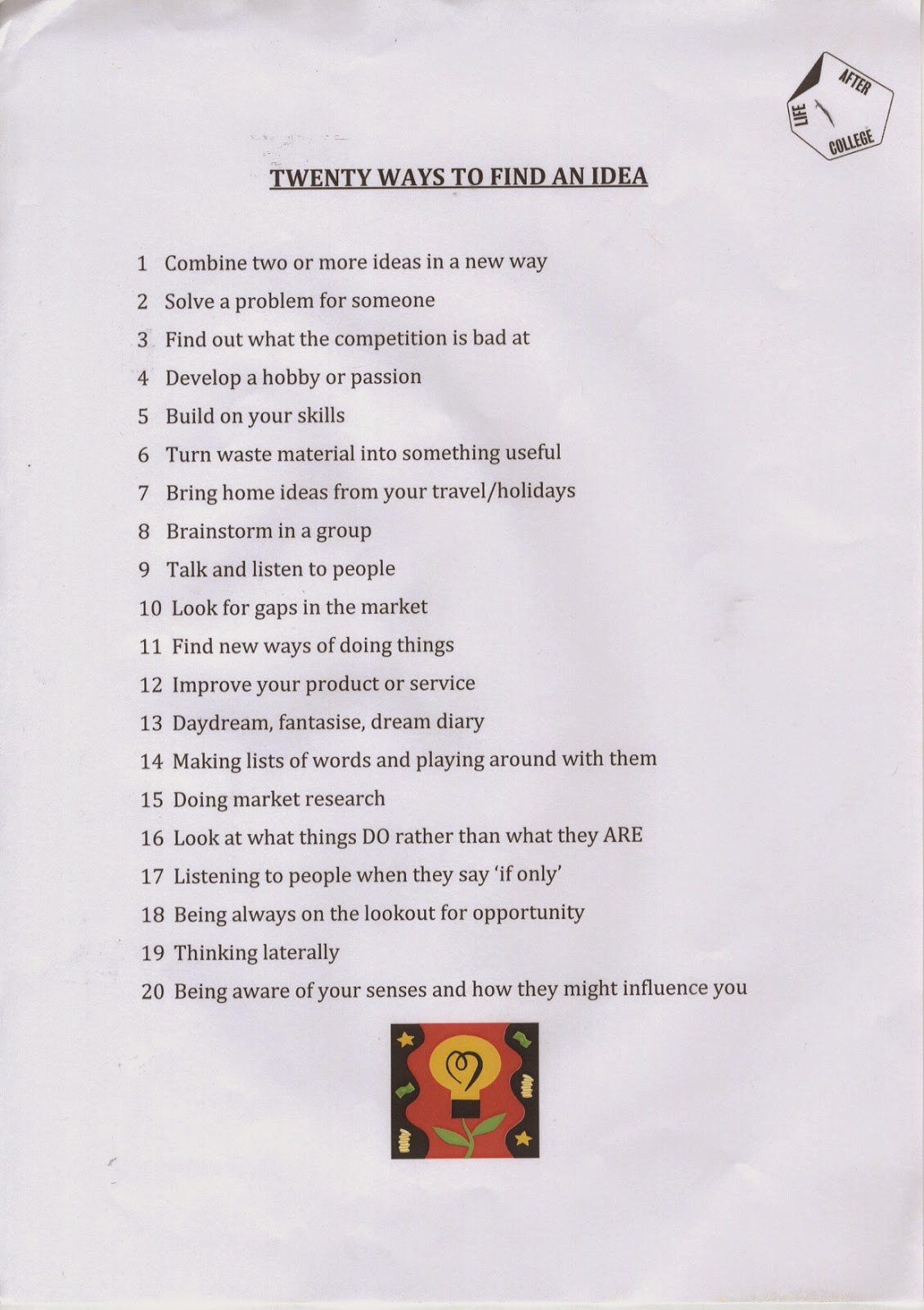
Finally, at the end of the session we were given two useful sheets, one containing a list of useful resources and the other details twenty ways to find an idea;